Here’s a mind-blowing fact: 73% of gym-goers make zero progress after their first month because they’re doing the exact same workout routine without any progression. That’s right—while you think you’re crushing it with your daily sweat sessions, your body has already adapted and stopped responding. Progressive overload training is the secret weapon that separates Hollywood A-listers from weekend warriors, and it’s simpler than you think.
1. What Progressive Overload Actually Means (It’s Not What You Think)
Progressive overload isn’t about lifting the heaviest weights in the gym or doing marathon CrossFit sessions until you collapse. According to the American Council on Exercise, it’s the gradual increase of stress placed on your body during exercise training.
Dwayne “The Rock” Johnson didn’t build his legendary physique by doing the same workout for years. His trainer, Dave Rienzi, constantly adjusts The Rock’s training variables every 2-3 weeks to keep his muscles guessing.
The principle works through five key variables:
- Weight/Resistance: Adding more pounds to your lifts
- Volume: Increasing sets or reps
- Frequency: Working out more often
- Intensity: Going harder during each session
- Time Under Tension: Slowing down your movements
Research shows that without progressive overload, your body reaches a plateau in just 6-8 weeks. That’s why Jennifer Lopez works with trainer Tracy Anderson, who’s famous for constantly evolving her celebrity clients’ routines to prevent adaptation.
2. The Science Behind Why It Works So Well
Your body is incredibly smart—almost too smart for its own good. When you perform the same exercises with identical intensity week after week, your muscles, cardiovascular system, and nervous system all adapt to meet those specific demands.
A 2024 study published in the Journal of Strength and Conditioning Research found that participants who followed progressive overload principles saw 67% greater strength gains compared to those who maintained static routines.
Chris Hemsworth’s transformation for Thor wasn’t accidental. His trainer, Luke Zocchi, systematically increased Chris’s training load every week using the Centr app methodology. Week 1 might involve 3 sets of 10 push-ups, but by week 8, Chris was performing weighted push-ups with 45-pound plates.
The magic happens at the cellular level. Progressive overload triggers:
- Increased protein synthesis in muscle fibers
- Enhanced mitochondrial density for better energy production
- Improved neuromuscular coordination
- Greater bone density through mechanical stress

3. How A-List Celebrities Actually Apply Progressive Overload
Scarlett Johansson didn’t just “get in shape” for Black Widow—she followed a meticulously planned progressive overload program designed by her trainer, Eric Johnson. Her routine started with bodyweight exercises and gradually incorporated Olympic lifting movements.
Here’s how the pros structure progressive overload across different training styles:
Strength Training Progression:
- Week 1-2: Learn the movement pattern (60-70% max effort)
- Week 3-4: Increase weight by 5-10%
- Week 5-6: Add an extra set or 2-3 more reps
- Week 7-8: Introduce advanced variations
Cardio Progression (Peloton Method):
- Week 1: 20 minutes moderate intensity
- Week 2: 25 minutes same intensity
- Week 3: 20 minutes higher intensity intervals
- Week 4: 30 minutes mixed intensity
Celebrity trainer Gunnar Peterson, who works with the Kardashians, swears by the “10% rule.” According to Peterson in a recent Shape magazine interview, “Never increase your training load by more than 10% per week. This prevents injury while ensuring consistent progress.”
4. The Biggest Progressive Overload Mistakes (And How to Fix Them)
Most people think progressive overload means adding weight every single workout. Wrong. Hugh Jackman’s trainer for Wolverine, David Kingsbury, revealed that Hugh sometimes spent 3-4 weeks perfecting form before increasing intensity.
Common Mistake #1: Too Much, Too Soon
Jumping from 20-pound dumbbells to 35-pound dumbbells overnight is a recipe for injury. Research from the American College of Sports Medicine shows that gradual progressions reduce injury risk by 40%.
Common Mistake #2: Only Focusing on Weight
Gal Gadot prepared for Wonder Woman by increasing workout frequency from 3 to 6 days per week, not just lifting heavier weights. Her trainer, Hayley Bradley, emphasized movement quality and endurance alongside strength.
Common Mistake #3: Ignoring Recovery
Progressive overload includes progressive recovery. As your training intensity increases, so should your sleep quality, nutrition precision, and stress management techniques.
| Training Variable | Beginner Progression | Intermediate Progression | Advanced Progression |
|---|---|---|---|
| Weight Increase | 2.5-5 lbs per week | 5-10 lbs every 2 weeks | 2.5-5 lbs per month |
| Rep Progression | 1-2 reps per week | 2-3 reps every 2 weeks | Focus on intensity over volume |
| Set Addition | 1 set every 2 weeks | 1 set per month | Maintain sets, vary intensity |

5. Your 4-Week Progressive Overload Action Plan
Week 1: Foundation Phase
Start with movements you can perform with perfect form for 8-12 repetitions. Choose 6-8 exercises targeting all major muscle groups. Document everything—weight, reps, sets, and how you feel.
Week 2: Volume Increase
Add one extra set to each exercise OR increase reps by 10-15%. Don’t touch the weight yet. Focus on mind-muscle connection and controlled movements.
Week 3: Intensity Boost
Now you can increase resistance by 5-10%. Alternatively, slow down your tempo—take 3 seconds to lower the weight, pause for 1 second, then lift explosively.
Week 4: Variation Integration
Introduce slight exercise variations. Regular push-ups become decline push-ups. Basic planks become side planks with leg lifts. This challenges your muscles in new ways without completely changing your routine.
According to trainer Don Saladino, who has worked with Blake Lively and Ryan Reynolds, “The fourth week should feel challenging but not impossible. If you’re struggling to complete your sets with good form, scale back 10%.”
Nike Training Club app uses this exact 4-week progression model in their premium programs, with built-in assessments to ensure you’re ready for the next phase.
Frequently Asked Questions
How often should I increase the difficulty of my workouts?
Every 1-2 weeks for beginners, every 2-3 weeks for intermediate exercisers, and every 3-4 weeks for advanced athletes. Listen to your body and prioritize form over ego.
Can I apply progressive overload to yoga and Pilates?
Absolutely. Progress from basic poses to advanced variations, increase hold times, or add resistance bands. Tracy Anderson incorporates progressive overload principles into all her celebrity Pilates sessions.
What if I hit a plateau despite following progressive overload?
Plateaus are normal. Take a deload week at 60-70% intensity, then switch up your primary progression method. If you’ve been adding weight, try adding reps instead.
Is progressive overload safe for beginners?
Yes, when done correctly. Start with bodyweight exercises and focus on movement quality for the first 2-4 weeks. Consider working with a certified trainer for the first month to establish proper form.
You might also like
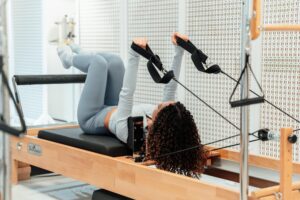 This 30-Minute Pilates Flow Makes All Your Muscles Shake Using Only A Mat